Binary Trees PROJECT
By Autumn C. Spaulding with Alyce Brady
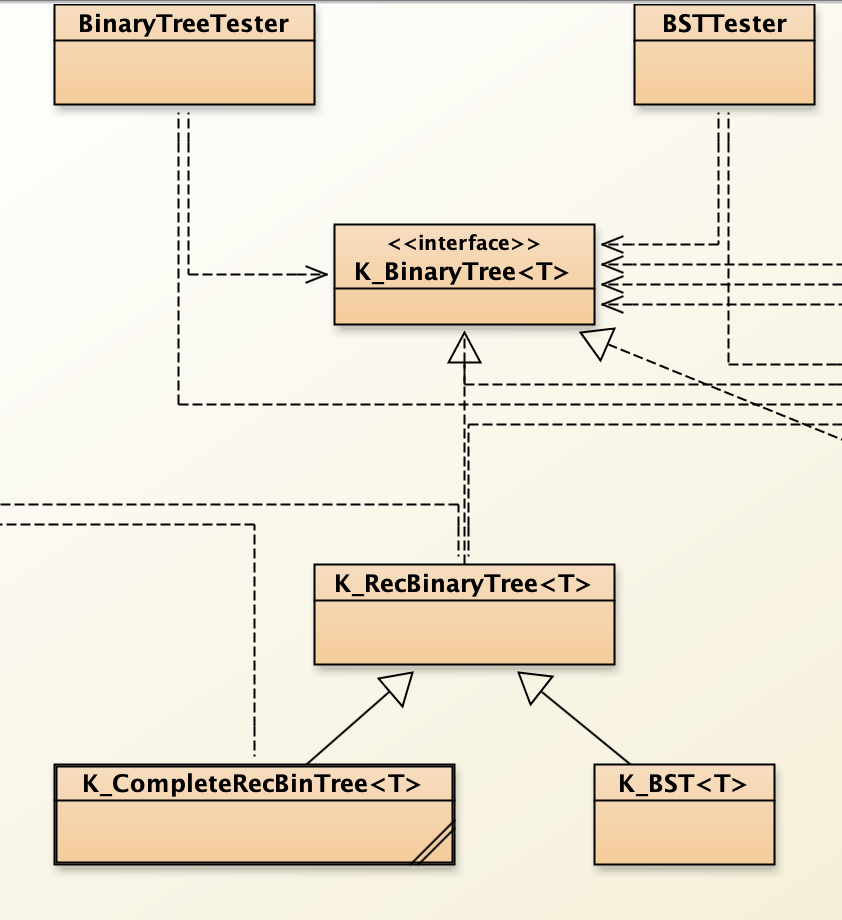
Over the next few labs you will be working with several different Binary Tree data structures. The incomplete
class diagram on the right shows a K_BinaryTree interface,
with a K_RecBinaryTree class that implements the interface as
a recursive data structure. The diagram also shows two subclasses of
K_RecBinaryTree that provide more specialized binary trees
— K_CompleteRecBinTree, which implements a recursive
Complete Binary Tree, and K_BST, which implements a Binary
Search Tree — as well as two related test drivers,
BinaryTreeTester and BSTTester.
This lab will focus on K_RecBinaryTree and its
K_CompleteRecBinTree subclass; a future lab will focus on
K_BST.
Implementing a Binary Tree
A recursive definition of a binary tree is that it is either:
- An empty tree; or
- A node, called a root, containing the data and two children, left and right, each of which is itself a binary tree.
Understanding the Code
In preparation for this lab, you should be familiar with the general methods and properties of binary trees. You should also be familiar with the concept of tree traversal methods. In this lab you will implement client code to construct a tree, and you will implement several traversals.
- Download six files into a new
Treesfolder:- K_BinaryTree.java: The Binary Tree interface.
- K_RecBinaryTree.java: A partially implemented class that defines the structure and methods for a recursive binary tree. It does not support removing elements from a tree.
-
K_CompleteRecBinTree.java:
A subclass of
K_RecBinaryTreethat supports removing elements from a tree in a way that preserves its nature as a Complete Binary Tree. - BinaryTreeTester.java:
A test driver, containing the
mainmethod and a number of tests. - NodeVisitor.java: described later.
- PrintAction.java: described later.
- K_BinaryTree: Look over the
K_BinaryTreeinterface to see which methods are specified. - K_RecBinaryTree:
Look at the
K_RecBinaryTreeclass. Start with the class documentation at the top of the file and then look at the instance variables, constructor(s), and basic observer methods (isEmpty,getData,leftChild, andrightChild) to see how this implementation represents empty trees, leaves, and non-leaf nodes. - Look at the javadoc comments for the
addmethod and re-read the class documentation to understand why instances of this class happen to always be complete binary trees. (What is a complete binary tree?) - Note that
K_RecBinaryTreedoes not support aremovemethod, throwing anUnsupportedOperationExceptioninstead.Stop and Think: Why is removing a node from a binary tree trickier than removing a node from a linked list? Does it matter whether the node you might want to remove is a leaf node, a non-leaf node with non-empty left and right children, a non-leaf node with an empty left child, or a non-leaf node with an empty right child? If you could remove an arbitrary node from a tree, would the tree still qualify as a complete binary tree? - There are several other methods in
K_RecBinaryTree, some of which have not been fully implemented. You can delay reading them until you get to the implementation phase. - K_CompleteRecBinTree: Read the class documentation
for the
K_CompleteRecBinTreeclass. The purpose of this class is to provide a "complete" implementation for a complete binary tree, including support for aremovemethod. Look at the javadoc comments and signatures for the methods without reading all of the code in the method bodies. What instance variables, constructor(s), or methods does this method have? Is that what you expected? - Look again at both
K_RecBinaryTreeandK_CompleteRecBinTree. How many constructors do these classes have? Is that what you expected? Can we construct empty trees and trees with internal nodes and leaf nodes with the methods provided, or do we need additional methods for basic tree construction?
Initial Experimentation
Identify Expected Results
- Look over the
BinaryTreeTestertest driver and theK_RecBinaryTreeandK_CompleteRecBinTreeclasses. What do you expect will be the result if you run the program without modifying any of these three classes?Tip: Always explicitly identify expected results before running a test. If it is complicated, write your expected results down. Otherwise it is too easy to see actual results and say, "Yeah, that looks right," even if the results are close but wrong. -
Note that the test driver adds values (12,
7, 3, etc.) to the tree. What tree do you expect this to
construct? Draw it out. What should be the result of a pre-order
traversal? A breadth-first traversal?
The tree expects
Integerobjects rather thanintvalues, but Java "auto-boxing" will turnintvalues intoIntegerobjects automatically, when needed.
Actual Results - Run the Code
- Copy your queue interface and class, along with the linked list
classes used by your queue implementation, into your
Treesfolder. - Compile and run the
BinaryTreeTesterprogram as provided. Did it behave as expected? If not, study the code further to understand why not. Was the problem with the actual results, or with your expected results? Study the code to understand any differences in behavior. -
How much of the
K_RecBinaryTreeandK_CompleteRecBinTreeclasses can you test with the methods you have so far? What more would you need to test it more thoroughly?
Understanding Visitors
Find the method in the K_RecBinaryTree class for doing a
pre-order depth-first traversal. Notice that it takes a single
NodeVisitor parameter.
NodeVisitor is an
interface that specifies a single method, the visit method.
The visit method also takes a single parameter, which is a
node in a binary tree. A traversal could consist of stepping through
all the nodes in a tree in a particular order and calling the
visit method of a particular NodeVisitor object
for each node. This allows us to write generic traversal algorithms that
can do a number of different activities. For example, we might have one
NodeVisitor object that prints each node (see the
PrintAction class), another that sums up numeric values in
each node, and another that finds the minimum or maximum node value. Each
of these tasks requires traversing the tree, but we don't need to write a
separate traversal algorithm for each activity. Instead, we write traversal
algorithms for each traversal ordering, and pass to each one an
appropriate NodeVisitor object. The NodeVisitor
is responsible for executing the appropriate action.
-
Read over the
NodeVisitorinterface and thePrintActionclass. Do you see how this could result in printing all of the data elements in the tree if thevisitmathod in thePrintActionclass were called for each node in the tree?
Recursive Depth-First Traversals
Remember that, in addition to breadth-first traversals, there are three depth-first ways to traverse a tree.
Because of the recursive nature of the binary tree structure, the
depth-first traversals can be implemented with recursion. Here is the
algorithm for traversing a tree using a pre-order traversal:
if the tree is not empty, ("visit" the root
view or do something with
the root)
recursively do a pre-order traversal of the left subtree
recursively do a pre-order traversal of the right subtree
Question: What is the base case for this recursive algorithm?
-
Note that although the
preOrderTraversalmethod inK_RecBinaryTreehas not been completed, thepostOrderTraversalmethod has been. Add code to the test driver to test thepostOrderTraversalmethod. How do you expect the program to behave now? Be explicit about exactly what you expect the results to be. Run the program. Did the actual results match your expected results? If they did not match, was the problem with the actual results, or with your expected results? Study the code to understand any differences in behavior. -
Compare the provided
postOrderTraversalmethod with the algorithm above. Implement thepreOrderTraversalmethod inK_RecBinaryTreeusing the algorithm above and the implementation of thepostOrderTraversalmethod as guides. Specify what results you expect to see when you run the program. Run it. Did the actual results match your expected results? If they did not match, was the problem with the actual results, or with your expected results? -
Implement the
inOrderTraversalmethod. Add code to the test driver to test your completed method. Are the results the same or different from your previous results with the pre-order traversal? Are the results what you expected?
Breadth-First Traversal
- Read over the
addmethod to see how it adds elements in breadth-first order. - Implement the
breadthFirstTraversalmethod inK_RecBinaryTreeusing a queue and a loop similar to that in theaddmethod. (ThebreadthFirstTraversalmethod is simpler, though.) Re-run the program. Are the results what you expected?
Additional Methods
Add signatures for the following methods to the K_BinaryTree
interface.
-
isLeaf()Returnstrueif the node is a leaf node;falseotherwise. (This method is not recursive, but could be used by other recursive methods.) -
numNodes()Returns the number of nodes in the tree. -
numLeaves()Returns the number of leaves (nodes with no non-empty children) in the tree. -
contains(T item)Takes an object as a parameter and returnstrueif the object is in the tree;falseotherwise. -
numOccurrences(T item)Takes an object as a parameter and returns the number of occurrences of the object in the tree.
Implement these methods in K_RecBinaryTree. Most of
these methods will follow a typical depth-first recursive algorithm, but
with more explicit handling of the base case than the traversal algorithms
above. Some may need to handle more than one base case, such as both empty
trees and leaves. The existing height method in
K_RecBinaryTree is similar to a post-order traversal, while
the algorithm below is an example of pre-order handling. A different order
may be appropriate for some methods.
        if the tree is empty,

            handle this base case

        otherwise,

            do something with the root

            recursively call this method for the left subtree, possibly doing something with the return value

            recursively call this method for the right subtree, possibly doing something with the return value
Add appropriate tests to your test driver.
Other Visitors
We can add new functionality to the program without having to modify the
K_RecBinaryTree class if the behavior is just based on the data
values in the tree and not their relationships to each other. We can do
this by creating new Visitor classes.
-
Implement a new class (name it
SumReduction), similar to thePrintActionclass, that implements theNodeVisitorinterface. Note that this class specifies that the data elements in the binary tree nodes areIntegerobjects. Your class should sum the data elements in thevisitmethod, keeping track of the sum as anintinstance variable. (The method should never be called with a null data parameter, but it is still a good idea to check for that before adding the value to the sum.) Your new class should also have an additional method that returns the sum. Modify the test driver to test your ability to calculate and then print the sum. -
Another useful method for a binary tree would be a method that
calculated the maximum or minimum value in the tree. Implement a new
NodeVisitorclass calledExtremeValueCalculatorto find the extreme values (minimum and maximum) in a tree. TheExtremeValueCalculatorclass should have twoComparableinstance variables, representing the largest and smallest values seen so far. In thevisitmethod, if thedataparameter isnull, do nothing. If it is notnull, then cast it to aComparableand test it against the smallest and largest values seen so far. (Document the precondition that the parameter must beComparable.) If either of the instance variables arenull, or if the parameter is smaller than the smallest value or larger than the largest value seen so far, then set the appropriate instance variable to the parameter. (Could the parameter become both the smallest and the largest value seen so far? Be sure to handle this case.) Provide additional methods that you can call from the test driver after the traversal is complete, one of which will return the minimum value and one of which will return the maximum value (bothComparable). Test your new class by using it in a traversal and then asking for the minimum and maximum values.
numNodes, contains, and
numOccurrences above could have been implemented as
visitors rather than embedded methods in the K_RecBinaryTree
class. The numLeaves method, on the other hand, could not,
unless the NodeVisitor interface were changed so that the
visit method takes a node as a parameter rather than just
the node's data element.
Clean and Refactor
Follow this link to clean and refactor your comments and code.
Submission
Submit your completed program through Kit, under Binary Tree.
Have fun! And if you have any questions remember I am available through email, Teams, and my office hours. And don't forget the Collaboration Center, which is a great place to work and ask questions too!
← back to the schedule