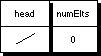
Empty List
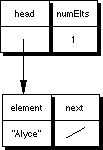
List with One Element
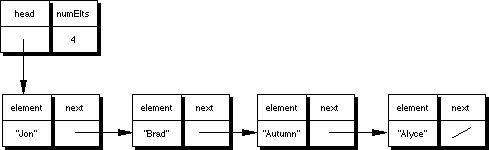
List with Multiple Elements
In the Bad News Bearers Lab, you saw how to build up a linked list and traverse
it, using the standard Java LinkedList class (a class in java.util
that implements a doubly-linked list). In this lab, you'll be focusing
on implementation, using the simpler LinkedNodeCollection and DoublyLinkedNodeCollection
classes.
ListNode

classLinkedNodeCollection class.
Read the class, focusing on its instance variables and constructor, and on
the ListNode class. LinkedNodeCollection
class: size, isEmpty, contains,
and iterator. Also implement the hasNext and
next methods in the LinkedNodeCollectionIterator
class. Test your changes by writing a test driver (similar to the Bad
News Bearers program) that creates a linked collection, tests whether it is
empty, adds elements to it, tests again whether it is empty, asks it for its
size, and so on.DoublyLinkedNodeCollection class, in
which each node has a reference to the previous node in the list as well as
to the next one, and in which the collection maintains a reference to the
last node in the list (the tail) as well as to the first node
(the head). Identify and draw diagrams for the "extreme
examples" (or boundary cases) of a doubly linked collection, similar to the
diagrams below for a singly linked collection. How many "extreme examples"
are there for a doubly linked collection? |
Empty List
|
List with One Element
|
|
List with Multiple Elements
| |
DoublyLinkedNodeCollection
class. Specify the class's instance variables, constructor, and the
ListNode class. Implement the size, isEmpty,
contains, and iterator methods in DoublyLinkedNodeCollection
and the hasNext and next methods in the nested DoublyLinkedNodeCollectionIterator
class, just as you did for LinkedNodeCollection. (For the
rest of the methods, you may copy the skeleton methods that throw UnsupportedMethodException
from the LinkedNodeCollection class.) isEmpty
method in LinkedNodeCollection?
Author: Alyce Brady abrady@kzoo.edu